Custom Reusable Shopping Bags: A Retail Program Guide
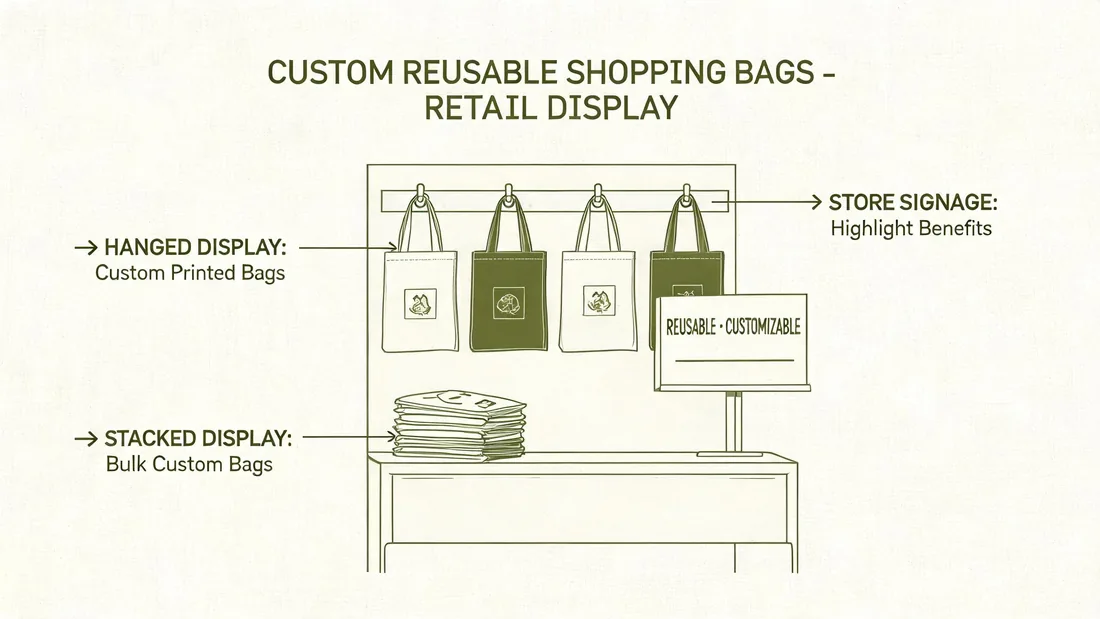
Custom reusable shopping bags look simple. They are not. A bag that fails after three trips costs a retailer more than the unit price. A bag that survives two years of trunk duty becomes a walking advertisement. This guide covers what actually decides which one you get.
You are not buying a bag. You are buying a number of trips, a load rating, a print surface, and a packing cube of logistics. Get one of those wrong and the program underperforms.
Start With the Assortment, Not the Artwork
Most retailers overcomplicate the first conversation. They send artwork before they have decided how many SKUs they need. That is backwards.
A grocery chain does not need the same bag as a boutique. The grocery buyer needs a bag that holds 15 pounds of cans and bottles, stands up in a trunk, and wipes clean. The boutique buyer needs a bag that looks good hanging near the register. Same category. Different brief.
Think in three layers. First, a workhorse bag for heavy loads. Second, a midweight bag for general shopping. Third, a lightweight bag for produce, pharmacy runs, or impulse purchases. A buyer ordering 800 units in three colors has a different problem than a buyer ordering 50,000 units in one color. The assortment drives everything downstream: fabric, construction, print method, and carton count.
Do not let a supplier quote you until they know the load target. Say a bag must carry 12 pounds without the handles tearing. That is a different seam spec than a bag rated for 5 pounds. The load target is the first number that matters.
Material Selection Against Real Reuse
Reusable shopping bags get punished. They sit in hot cars, get stuffed under sinks, and get washed in machines they were never designed for. The material choice has to match that abuse.
Woven polypropylene is the default for grocery programs. It is cheap, printable, and stiff enough to stand open. But the coating matters. An uncoated woven bag absorbs spills and holds odors. A coated one wipes clean and lasts longer. The coating weight is set in the approved specification, not guessed.
Nonwoven polypropylene feels softer and folds smaller. It is fine for light loads and short reuse windows. Do not promise a nonwoven bag for heavy canned goods. The handles will fail first.
Cotton canvas and cotton duck are heavier, washable, and more expensive. They suit premium retailers who want the bag to be part of the brand. A waxed cotton finish sheds water but creases and marks with use. That is not a defect. It is the material behaving as it should.
Ripstop nylon or polyester works for foldable bags that live in a glovebox. The reinforcement yarns limit tear propagation. The denier and GSM are specified per project. Denier does not directly state finished fabric strength, so do not compare two bags by denier alone.
Recycled content is available in polyester and woven polypropylene. If your program requires rPET or post-consumer material, state it in the RFQ. Do not assume every factory can source it at your volume.
Construction Points That Decide Survival
This is where most quotes hide the difference. Two bags can look identical in a photo and behave completely differently after 50 trips.
Handle Attachment
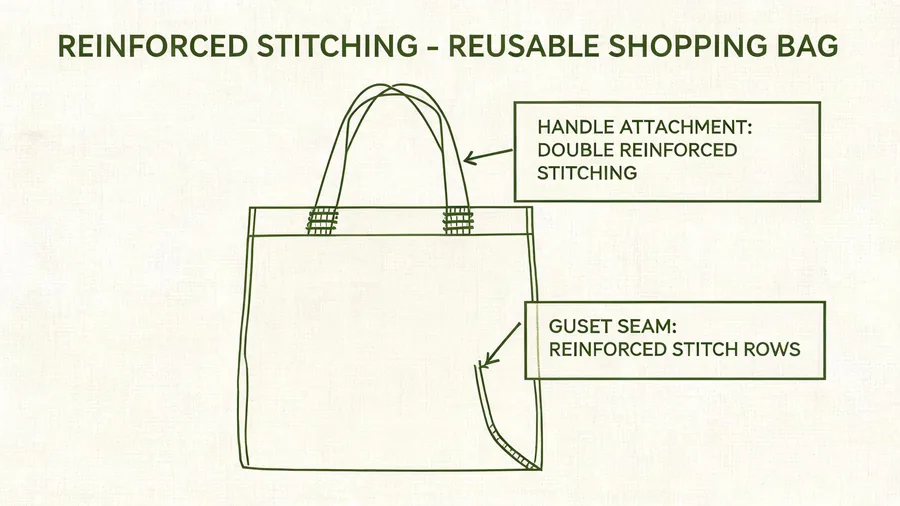
Handles are the failure point. A handle sewn flat into the top hem can tear out under load. A handle that wraps under the bag body and is stitched through the base distributes force better. That detail costs more. It also survives.
Ask the supplier how the handle is anchored. If they cannot answer in one sentence, ask for a cross-section photo. The answer should mention stitching through the body panel or a reinforcement patch at the attachment point.
Base Reinforcement
A bag that sags in the middle is annoying. A bag with a plastic board or fiberboard insert in the base holds its shape and protects the bottom seam. The insert material depends on whether the bag will be machine washed. Fiberboard does not like moisture. Plastic board does.
Seam Type
A single-needle seam is fine for a lightweight produce bag. A heavy grocery bag needs a bound seam or a double-stitched seam with reinforcement at the gusset corners. The workmanship standard defines the acceptance criteria. Get it in writing.
One more thing. Get a pre-production sample and abuse it. Load it with twice the target weight. Carry it around the block. Wash it once. If the handles survive, you have a real spec. If they do not, you just saved a container of returns.
Print Method and Durability
The print is the brand. It is also the first thing to look bad. Choose the method based on the material and the expected wash cycle.
Screen printing works well on flat woven panels and nonwoven fabric. Solid colors, repeat production, good cost at volume. The ink system must match the substrate or it flakes.
Dye sublimation works on polyester surfaces. It bonds the dye into the fiber under heat and pressure. That means the print will not crack or peel the way a surface print can. But it only works on suitable polyester. Not on cotton canvas.
Heat-transfer graphics are fast and flexible for short runs. The catch is adhesion and wash performance. A transfer that looks great on day one can delaminate after three washes. Validate it on the actual fabric, not a sample swatch.
Embroidery is durable and premium, but it adds cost and changes the panel stiffness. It works for logos on canvas or heavier polyester. Not for full-bleed graphics.
The color standard and lab dip process matter more than the print method. Approve a physical color standard before bulk. A digital proof on your screen will not match the dyed fabric. The tolerance is defined in the spec, not in the marketing email.
Packing and Distribution Logistics
Bags are bulky. They are light but they eat carton space. A container of reusable shopping bags is often volume-limited, not weight-limited. That changes your landed cost math.
Flat-packed bags cost less to ship than pre-folded bags with inserts. But flat-packed bags arrive wrinkled. If the store needs them shelf-ready, specify folding and poly bagging. That adds labor cost and carton count.
Carton dimensions should be set before production, not after. A carton that is 2 inches too tall wastes 15% of a container. A carton that is too tight crushes the bags. The packing spec is part of the tech pack, not an afterthought.
Distribution has two common models. The retailer ships to a central warehouse and distributes to stores. Or the factory ships directly to individual stores. The second model saves time but requires the factory to handle per-store carton packing and labeling. Not every supplier does this well. Ask before you assume.
For small test programs, air freight or express courier works. For a chain rollout, ocean freight is the standard. The lead time difference is weeks, not days. Plan the reorder point accordingly.
Honest Talk About Reuse Counts
A supplier who promises a bag will last exactly 125 trips is guessing. Reuse count is a rule of thumb, not a guarantee. The real number depends on load, handling, washing, and storage.
A bag rated for 20 pounds will fail faster if you routinely put 30 pounds in it. A bag left in a hot car every day will degrade faster than one stored indoors. UV exposure breaks down polypropylene. Moisture rots cotton. These are material behaviors, not defects.
What you can do is define the test. State the target load, the number of wash cycles, and the failure mode you care about. Then the supplier can build to that spec. A bag that survives 50 cycles at 15 pounds is a measurable thing. A bag that lasts "a long time" is not.
Imagine a buyer who orders 10,000 bags for a summer promotion. The bags sit in a hot warehouse for three months before distribution. The handles are fine. The print is fine. But the coating has started to stick together because the spec did not account for storage temperature. That is a preventable failure. It is also the kind of thing that never shows up in a quote.
For more on woven material options, see our PP woven shopping bags page. If your program includes beach or seasonal use, the beach bags section covers different construction priorities. And if you are comparing natural fibers, the raffia vs straw comparison explains the trade-offs.
Program Planning Checklist
Use this before you send the RFQ. It will save you two rounds of back-and-forth.
| Decision | What to Specify | Why It Matters |
|---|---|---|
| Load target | Maximum weight per bag, in pounds or kilograms | Drives handle attachment and seam spec |
| Reuse expectation | Number of trips or wash cycles | Drives material and coating choice |
| Assortment | Number of SKUs, colors, and sizes | Sets print and carton complexity |
| Print method | Screen, sublimation, transfer, or embroidery | Must match the material and wash cycle |
| Packing spec | Flat pack, folded, poly bagged, carton dimensions | Controls freight cost and shelf readiness |
| Distribution | Central warehouse or direct-to-store | Changes factory packing and labeling requirements |
| Test criteria | Load, cycles, and failure mode | Turns a vague promise into a measurable spec |
Get the pre-production sample before you approve bulk. Abuse it. Then approve the golden sample and lock the spec. Change control after that point is expensive.
If you want to talk through a program, contact us with your load target and assortment. We will tell you what holds up and what does not.
Frequently Asked Questions
What material is best for reusable grocery shopping bags?
Woven polypropylene with a coating is the standard for heavy grocery loads. It is stiff, printable, and wipes clean. Nonwoven polypropylene works for light loads. Cotton canvas suits premium retail but costs more.
How many times can a reusable shopping bag be reused?
There is no fixed number. Reuse count depends on load, handling, washing, and storage. Define the target load and wash cycles in your spec, then test a pre-production sample against that.
What MOQ applies to custom reusable shopping bags?
MOQs vary by material and design. Woven bags, nonwoven bags, and canvas bags have different minimums. Contact us with your material and print requirements for a quote.
How do I keep the print from cracking or peeling?
Match the print method to the material. Dye sublimation bonds into polyester and will not crack. Screen printing needs a compatible ink system. Heat transfers require wash testing on the actual fabric.
Sourcing woven bags?
Send your questions to the factory directly. We reply within 24 hours.
Request a Quote