Leather Bag Manufacturer for Accented Woven Bags
Why leather or PU trims belong on woven bodies
Woven bodies built from raffia, paper straw, seagrass or rush bring texture and lightness, but they can feel unfinished at the stress points. Leather or PU trims at handles, straps, edge bindings and patchwork panels give those tactile surfaces a more resolved, boutique-ready silhouette.
For fashion brands and gift companies, a woven bag with structured trim reads as a considered design object rather than a beach-market item. The contrast between matte natural weave and smooth trim also makes the bag easier to photograph and style, which matters for Amazon listings and catalog pages.
PU vs natural trims in qualitative terms
Natural leather has an organic grain, softens with use and develops a patina, but it can carry more variation and requires more care at the price point. PU is more uniform in color, easier to clean and lighter in weight, which helps when bags ship flat or need consistent repeat production.
Neither option is automatically better. The choice depends on the brand's price point, care expectations and whether the line is positioned around natural material story or uniform, ready-to-ship repeatability.
- Natural trims: warmer hand feel, visible grain, evolving surface character, more variation between hides.
- PU trims: consistent finish, broad color matching, low maintenance, dependable for repeat orders.
Hardware and strap considerations
The attachment point matters as much as the strap material. On an open or loose weave, a thin strap can pull and distort the body, so buyers should review bar tacks, rivets and backing patches at the handle base.
- Wider straps or rolled leather handles suit larger woven totes; slim PU straps work better for small crochet or raffia styles.
- Match hardware finish across zipper pulls, feet and buckles: matte black, brushed nickel and polished gold each shift the style tone.
- Consider strap drop and handle length for shoulder carry versus hand carry, especially when a woven body has a soft base.
Small batch testing for boutique lines
Camytonc produces leather-accented woven bags with an MOQ of 50 pcs, the lowest tier in the company's woven bag program. That makes it practical to test a boutique colorway or a new handle direction before expanding into deeper inventory.
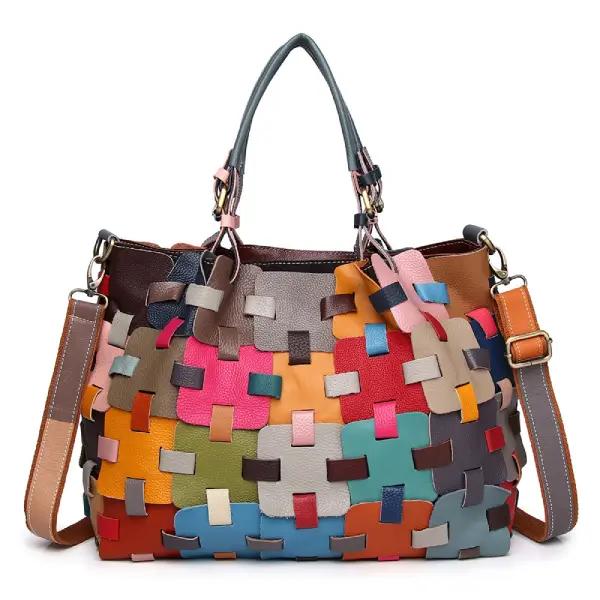
Because the MOQ is only 50 pcs, a boutique can test multiple colorways without deep inventory risk. Paid samples are available in 1-10 days depending on the construction, and one revision round typically takes 2-3 days. For buyers evaluating trim feel, stitch placement and hardware color, the woven leather patchwork bag is a useful reference style.
Styles in this material
Discuss leather bag manufacturer for accented woven bags for your line
We answer material questions before you commit to sampling. Replies within 24 hours.
Request a QuoteMaterials and Construction Options for Leather-Accented Woven Bags
A buyer searching for a leather bag manufacturer in the woven category quickly learns that leather is rarely the whole story. The bag body is usually straw, wicker, raffia, PP ribbon, or canvas. Leather appears as handles, base panels, trims, straps, and corner patches. That hybrid structure changes how you should spec the product. It also changes what fails first, which is what this section is about.
From the industry reference, the realistic material choices for the leather portion fall into a few families. Synthetic leather gives you a consistent surface and predictable color matching across production runs. Genuine leather brings texture and aging character but demands tighter incoming inspection. The table below lays out what each option is good for and where it causes problems in this specific category.
| Material | Good for | Where it fails |
|---|---|---|
| Synthetic leather (PU on textile backing) | Uniform color, lower cost, easy cutting for straps and patches | Peeling at edges after abrasion; heat sensitivity during storage |
| Synthetic leather (PVC on textile backing) | Stiff structured bases, strong moisture resistance, easy wipe-down | Can crack in cold conditions; heavier hand feel |
| Genuine leather, split grade | Soft drape for handles and trims, lower cost than full grain | Inconsistent surface; color variation between hides |
| Genuine leather, full grain | Durability, patina, premium positioning | High cost; natural marks make uniform branding harder |
| Waxed canvas with leather-look trim | Water shedding, casual aesthetic, lower material spend | Not a true leather substitution; buyers may reject on inspection |
For the woven body, the pairing matters as much as the leather itself. Straw and wicker are rigid. When you stitch a soft leather handle to a stiff straw panel, the stitch line becomes the stress concentration. A buyer who specs a full-grain leather handle on a tightly woven straw body without a reinforcement patch behind the anchor point will see tearing within a season. That is not a leather problem. It is a construction problem. The fix is a backing layer, usually a synthetic leather or nonwoven patch, placed inside the bag before the handle is stitched. This is standard practice for any experienced custom leather bag manufacturer working with woven shells.
Raffia and PP ribbon behave differently again. Raffia is fibrous and can shred when a needle passes through a dried section. PP ribbon is slippery and resists needle penetration cleanly. For both, the leather accent should be pre-punched before stitching. If the factory tries to sew through untreated raffia and a thick leather strap in one pass, you get skipped stitches and broken threads. Ask your supplier how they handle needle size and pre-punching for the specific woven body you have chosen. The answer tells you more than a catalog photo.
For a deeper look at the woven body options, see our straw, wicker and raffia material guide. The leather portion always follows the body material's limits.
How Buyers in Different Situations Should Specify This Product
Specification decisions change completely depending on who is buying and where the bag will sell. Three situations show the range.
Say a buyer is sourcing for a resort retail chain. The bag will sit on a shelf in a coastal store, handled by customers who pick it up by one strap and load it with sunscreen and a towel. The woven body is likely seagrass or water hyacinth. The leather accent should be a synthetic leather with a PU top coat, because salt air and sunscreen residue will stain untreated genuine leather within weeks. The buyer should spec a strap attachment with a double bartack and a backing patch. They should also ask for a UV exposure test on the leather color, because bright store lighting fades some dyes fast. The spec that changes the outcome here is not the leather type alone. It is the UV colorfastness rating and the attachment reinforcement.
Now consider a buyer developing a premium line for a boutique brand. The retail price supports genuine leather. The buyer wants full grain leather handles with visible grain and a natural edge finish. The woven body is a hand-loomed cotton or a fine raffia. Here the spec must include a temper callout for the leather. Too soft and the handle stretches out of shape. Too firm and it fights the soft drape of the bag. The buyer should also spec edge paint color and thickness, because a raw cut edge on full grain leather will absorb body oil and darken unevenly. This buyer needs to request a pre-production sample with the exact leather hide lot, not just a similar color swatch.
A third situation is a promotional buyer ordering a large run for a corporate gift program. The bag is a simple woven tote with a small leather patch logo. Cost per unit is the driver. The buyer should spec a split grade genuine leather or a PU synthetic, depending on the logo process. Debossing holds better on genuine leather. Foil stamping is more consistent on synthetic. The buyer also needs to decide whether the patch is sewn on or riveted. Sewing adds labor but allows replacement. Riveting is faster but the hole placement must be exact, because a misaligned rivet on a woven panel cannot be moved without leaving a visible mark. This buyer should lock the patch size, the attachment method, and the logo artwork dimensions before sampling. Those three decisions control most of the cost variance.
For more on how MOQ shifts across woven styles, see our straw bag MOQ sourcing guide.
Customization That Changes Tooling, Cost or Lead Time, Versus Customization That Does Not
Some changes are free. Some require new dies, new molds, or a longer line setup. Knowing which is which saves you from approving a quote you do not understand.
Changing the leather color on an existing bag pattern does not change tooling. You pick a new color from the supplier's leather swatch book and the factory cuts the same pattern. Lead time stays the same. Changing the woven body color is also usually free if the supplier already stocks that dyed fiber or ribbon. These are surface changes.
Changing the shape of a leather handle or base panel changes tooling. The factory cuts leather with steel rule dies. A new handle curve or a wider base means a new die. That adds cost and anywhere from a few days to two weeks depending on the die shop. The same applies to a new logo patch shape. A rectangle patch cut from an existing die is cheap. A custom die-cut patch in your brand's silhouette is a new tool. If your logo has fine detail, the die becomes more expensive and the cutting tolerance tighter.
Changing the attachment method also changes cost. Moving from a sewn leather patch to a riveted one adds hardware cost and a riveting station. Moving from a single-layer leather handle to a folded and edge-painted handle adds labor. These are not tooling changes, but they change the per-unit labor time and therefore the price. A buyer who asks for edge painting on all leather trims should expect a higher quote than one who accepts raw cut edges. The difference is real labor, not markup.
One change that surprises buyers is switching from synthetic leather to genuine leather mid-project. The material cost rises, but so does the cutting waste. Genuine leather hides have natural defects. The factory must cut around scars, holes, and loose grain. Yield drops. A hide that yields 80% usable synthetic pieces might yield only 60% in full grain leather. That yield loss appears in the price and sometimes in the lead time if the factory needs to order additional hides to cover the shortfall. If you plan to switch materials, do it before the first sample, not after the production order is placed.
For a related look at canvas bodies, see our cotton canvas material guide.
What to Check Before Approving Production for This Category
The pre-production checklist for leather-accented woven bags is different from a standard backpack or duffel. You are checking two material systems at once: the rigid woven body and the flexible leather accent. Each has its own failure modes.
Check the leather thickness against the spec. The industry reference defines thickness as measured under a stated pressure. A handle spec that calls for 1.4 mm leather should be measured with a thickness gauge, not eyeballed. If the factory substitutes 1.0 mm leather to save cost, the handle will stretch and the stitch holes will elongate. You will see it in the first month of use. Ask for a thickness reading on the pre-production sample and on the first production piece.
Check the stitch density at the leather attachment points. The reference calls out stitch density as part of the specification checklist. On a woven body, the stitches that hold the leather handle or base panel are the highest stress points. A loose stitch density here means the leather will tear away from the body. The fix is a tighter stitch count and a reinforcement patch behind the anchor. Your inspection should include a pull test on one handle from each carton, not just a visual check.
Check colorfastness on the leather. The reference lists colorfastness as resistance to color change or transfer during rubbing, washing, light exposure, or contact with moisture. For a leather accent, the relevant tests are crocking and lightfastness. Rub a white cloth against the leather. If color transfers, the bag will stain clothing. Expose a swatch to UV light for the specified hours. If the color shifts, the bag will look faded on the shelf. These are simple tests that catch expensive problems early.
Check the woven body for broken fibers or loose weave around the leather attachment points. A woven bag can look perfect on the front panel and be fraying behind the handle anchor. The inspector should turn the bag inside out and look at every point where leather meets woven material. Loose ends, skipped stitches, or a missing backing patch are all rejection reasons.
Finally, check the claim control language. If you plan to market the bag as "genuine leather trim," the entire leather portion must be genuine leather. A synthetic backing patch behind a genuine leather handle is acceptable if it is not visible and not described as leather. But if any visible trim is synthetic, the claim becomes false. Work with your supplier to define exactly which components are leather and which are not, then write the marketing copy to match. The same applies to terms like "water-resistant" or "durable." These are performance claims. They need test data behind them.
For a specific product example of leather patchwork on a woven body, see our woven leather patchwork bag.