Beach Bags Bulk: Wholesale Sourcing Guide
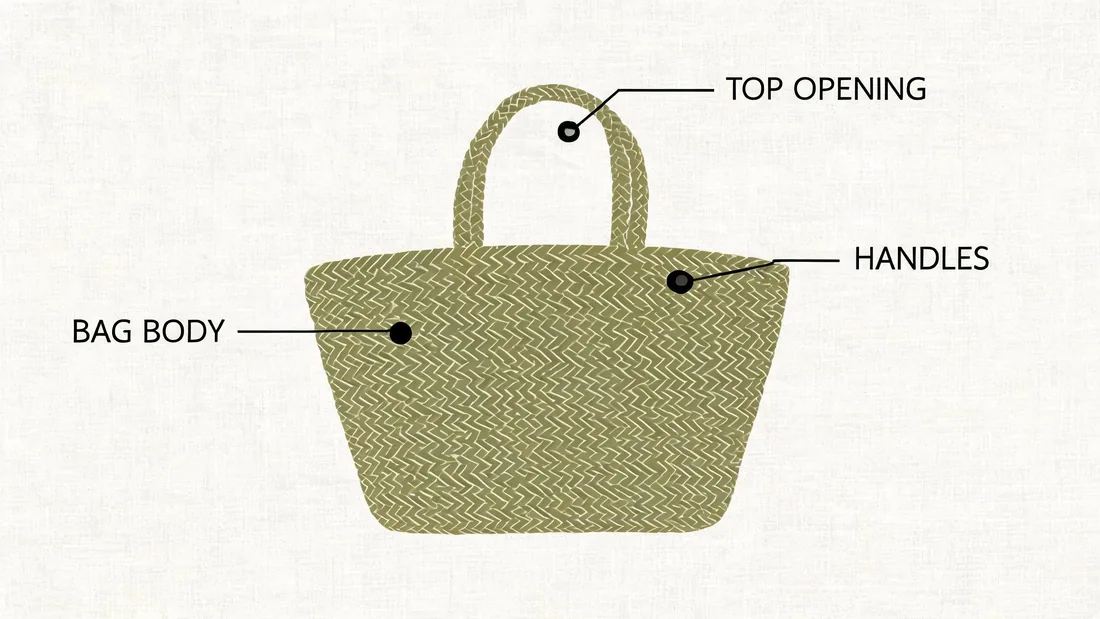
Beach bag bulk orders fail for boring reasons. Not because the design was wrong. Because the shell was chosen for a photo, the handle anchor was never reinforced, and nobody wrote a tolerance on the spec sheet. A bag that looks right in a sample room can come back as a complaint list after one summer of sand, salt and UV.
This guide walks through what actually decides whether a bulk beach bag programme survives its first season: shell material, lining and closure, handle and base construction, decoration, the spec document itself, and the tests worth requesting before anything ships.
Beach Bag Bulk Buying Starts With the Shell Material
Say a buyer is building a summer range for a coastal gift chain. Four shells get quoted: straw, raffia, cotton canvas and PP woven. On a screen they look similar. In a carton they behave nothing alike.
Straw and raffia are structural materials. They hold a shape with very little internal support, which is why a woven basket tote stands up empty on a shelf. That same stiffness makes them awkward to fold, so a straw programme usually ships as a nested or stacked carton rather than a flat-packed one. Freight volume per unit is higher. Raffia and straw also vary lot to lot in tone and fibre thickness, because they are agricultural materials, not extruded ones.
Cotton canvas behaves in the opposite way. It is soft, it folds flat, and it takes print and embroidery beautifully. Canvas is specified by ounce weight, and a heavier duck gives more structure and better abrasion performance. It also traps sand in the weave. That is not a defect, it is what a plain weave does. A buyer who wants sand to fall through should be looking at mesh, not canvas.
PP woven sits in the middle. It is light, cheap to move, wipes clean, and takes a laminated print well. It is also the shell most likely to feel disposable in the hand, which matters if the bag is meant to sit at a higher retail tier.
Mesh deserves its own line. An open mesh shell lets sand pass straight through, dries fast, and weighs almost nothing. It offers no structure and no privacy, so it usually appears as a secondary style in a range rather than the hero.
| Shell | Structure | Sand behaviour | Packs flat? | Best fit |
|---|---|---|---|---|
| Straw / raffia | High, holds shape empty | Falls through gaps | Poorly, stacks instead | Gift, resort, display-led ranges |
| Cotton canvas | Medium, softens with use | Traps in the weave | Yes | Print-led ranges, everyday totes |
| PP woven | Low to medium | Rinses out | Yes | Volume programmes, promotional |
| Mesh | Very low | Passes through | Yes | Secondary style, swim-adjacent |
UV and salt air treat these materials differently too. Natural fibres and dyed canvas fade and can lose strength over a season of direct sun. Synthetic yarns hold colour better against UV but degrade faster if the coating cracks. Neither outcome is a surprise if it is specified for up front.
Why material drives more than unit cost
Material choice sets the tooling, the folding method and the carton volume. A straw tote that cannot be folded costs more to ship than a canvas tote of the same retail price. That freight difference often outweighs the unit cost gap between shells, and it is the number most buyers forget to model.
Lining, Coating and Closure: What Survives Sand and Sun
Imagine a buyer approving a PEVA-lined inner surface because it wipes clean. Good call for a bag carrying wet swimwear. The same lining on a straw outer needs a seam treatment that keeps sand from working between liner and shell, or the liner starts to sag away from the body within weeks.
Lining options run from fully unlined, which is cheapest and fine for a dry-goods tote, through cotton lining, through film liners such as PEVA and other flexible films used for cleanable inner surfaces. Unlined straw looks honest and breathes. Lined straw looks finished and hides the weave back. Both are legitimate, they just serve different price points.
Coating is where vocabulary gets sloppy. A coating weight or a lamination is a specification. Water-resistant and waterproof are claims, and they are not interchangeable. Water-resistant applies when the material has passed a defined water-resistance method. Waterproof applies only when the complete construction, seams and closures included, meets the stated waterproof test conditions. A coated fabric that passes a spray test does not make the finished bag waterproof. Sand and salt find the seam first.
How closures handle sand
An open top is the most sand-tolerant closure because there is nothing to jam. A zip is the least, unless the zipper is specified with a covered or reversed construction that keeps grit out of the teeth. Drawstring closures sit between the two: simple, cheap, and prone to fraying at the grommet if the cord end is not finished. Roll-top closures seal well but add bulk and cost, and they suit a wet-carry bag more than a beach tote.
Zipper cycling is a standard component test, and it is worth asking for on any zipped beach style. The exact cycle count depends on the agreed specification, not on a rule of thumb.
Handles, Seams and Base Panels: The Parts That Fail First
Handles are where a cheap beach bag announces itself. Webbing, rope and braided cord all work, but the attachment decides the working life of the bag. A handle sewn straight onto the shell with a single row of stitching will pull out. A handle anchored through a reinforcement patch with a bar-tack or box-X at the stress point will not.
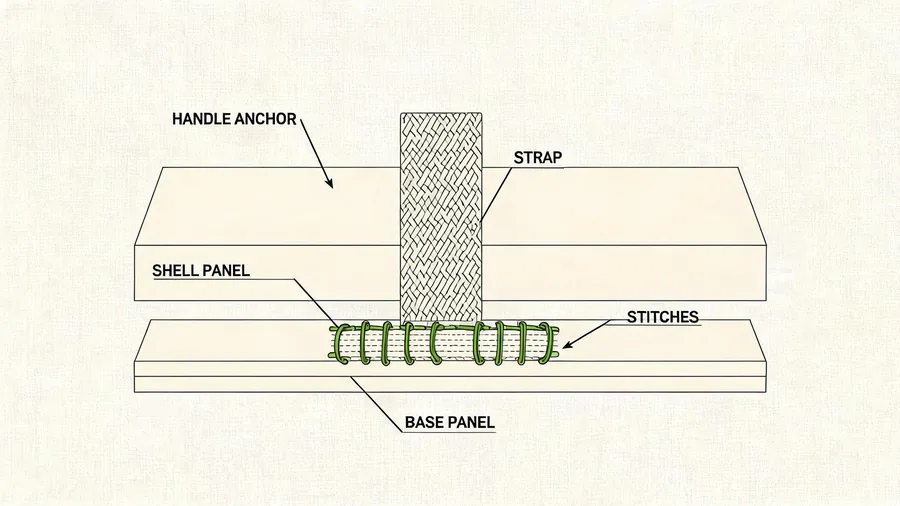
Say a buyer is shipping a tote meant to carry two towels, a bottle and a folded chair. That load concentrates at the handle anchor every single time the bag is lifted. A reinforcement patch is not decoration. It is the component that stops the shell from tearing at the stitch line.
Base panels matter for the same reason. A plastic board or a semi-rigid sheet insert keeps a loaded tote from sagging into a bag shape, and it protects the bottom seam from abrasion on sand and stone. Fiberboard stiffeners work too, but only where moisture exposure is controlled, which a beach bag is not.
Pre-production checks worth requesting
Seam strength measures the force required to break the seam, material or stitch system near a joint. Strap-anchor strength applies a controlled pull to the handle or webbing attachment to verify the reinforcement. Both are standard product-level checks, and both belong on the pre-production sample rather than on the first bulk shipment.
Customisation That Travels Well: Logo, Colour and Trim
Decoration routes differ by shell. Woven labels and heat-press transfers sit well on canvas and PP woven. Embroidery works on canvas and on a lined straw body, though a dense logo on coarse straw is a bad idea. Laser marking suits some coated and synthetic surfaces. On raffia and straw, a hang tag or a woven label sewn to the handle often beats anything applied directly to the weave.
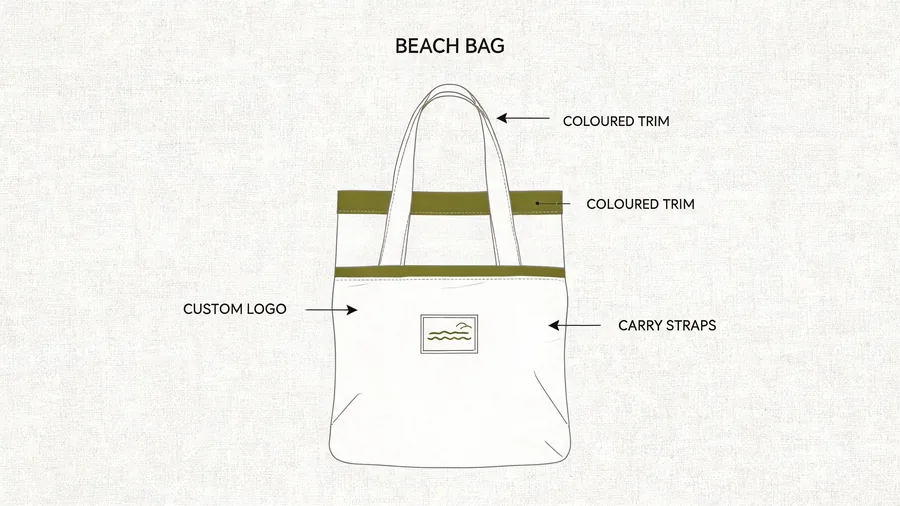
Colour is the quiet risk in any natural-fibre programme. Two lots of raffia will not match exactly. That is why a lab dip or a strike-off gets approved before bulk, and why the approved physical reference, sometimes called a colour standard, is kept alongside the golden sample. Pantone approval protects the bulk run. Nothing else does.
Trim choices carry their own exposure. PU or vegan leather handles look premium and handle well, but metal hardware on a beach bag faces salt air and moisture. Corrosion resistance is a standard finish test, and a buyer specifying metal rings, rivets or sliders should ask how that finish is evaluated.
Keeping a seasonal collection consistent across fabric lots comes down to change control: any revision to material, artwork or construction gets approved in writing before it reaches the line.
Writing the Spec: Tech Pack, BOM and Tolerances
A beach bag tech pack is the controlled document that ends most arguments. It holds dimensions, materials, construction details, artwork, labels, packaging and test requirements. The bill of materials lists every material, component, quantity, colour and supplier reference needed for one bag.
Dimensions need a tolerance, not just a number. A critical dimension is one that affects fit, function, component compatibility or safety, and it gets a tight tolerance. A cosmetic dimension gets a looser one. Writing "approximately" on a spec sheet is how a bulk run ends up with a base panel that does not fit the insert.
Two samples do the heavy lifting before mass production. The pre-production sample is made with the intended bulk materials and approved methods. The golden sample is the approved physical reference used to compare production workmanship and appearance. If a factory cannot produce a golden sample, the bulk run has no benchmark.
Quality Checks Before a Bulk Beach Bag Run Ships
Requesting the right tests is cheaper than a recall. On a beach programme, the useful ones are seam strength, colourfastness to rubbing, zipper cycling where a zip is used, and corrosion resistance on any metal hardware. Colourfastness to rubbing matters more than usual here because a damp, sandy bag rubs against swimwear and skin.
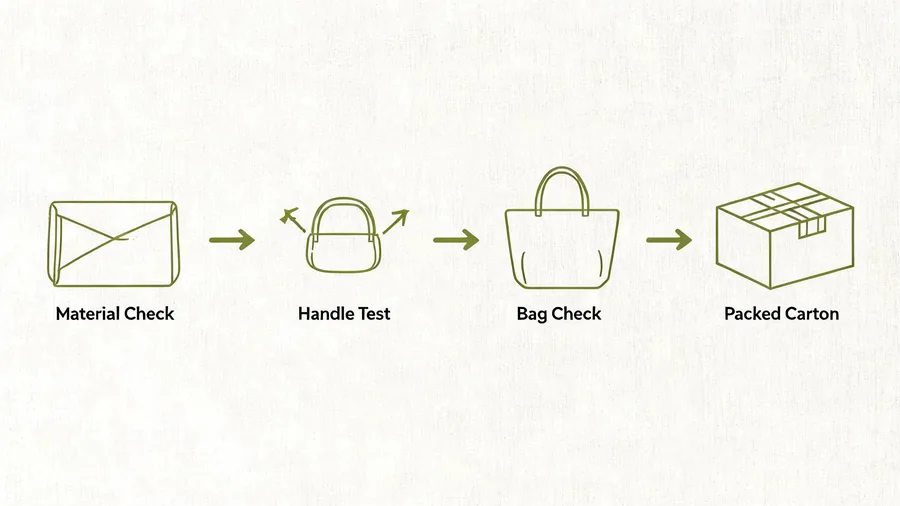
Water resistance and waterproof wording need care. A material test result should never be converted into a finished-product claim without confirming the complete construction, seams and closures included. If a claim cannot be supported by a test on the finished bag, it should not appear on the hang tag.
Inspection runs on AQL, which pairs a sampling plan with acceptance numbers, and defects are classified as critical, major or minor by risk and product impact. Visual workmanship inspection checks for skipped stitches, loose threads, stains, asymmetry, puckering, sharp edges and incorrect component placement. Approved test reports should stay linked to the exact material lot, component version and product revision, so a reorder can be traced back.
A checklist a buyer can copy
- Shell material and weight stated by construction, not by adjective
- Lining type, or a written decision to leave it unlined
- Coating or lamination stated as a spec, with claims kept separate
- Handle attachment method and reinforcement named
- Base panel material and insert dimensions
- Critical dimensions with tolerances
- Colour standard approved via lab dip or strike-off
- Test list agreed before the pre-production sample
- Packing format and folding method written down
Packing, Freight and Reorder Planning for Beach Bag Bulk Orders
Packing format changes carton volume, and carton volume changes freight cost per unit. Six common formats cover most programmes: poly bag, colour box, gift box with handle bag, branded poly mailer, hang tag with poly bag, and dust bag. A colour box adds cube and cost. A poly bag adds almost nothing.
Folding method matters just as much. A canvas tote folded twice packs tighter than one folded once, but a hard fold line can set into a coated surface. Straw and raffia usually cannot be folded at all, so they stack. That single difference can move a container from comfortably full to half empty, and it is worth modelling before the quote is signed.
Lead time runs in stages: sampling, material purchasing, production, inspection and packing. Each stage has its own duration, and the total depends on the shell, the decoration and the order size. A buyer planning a summer launch should work backwards from the shelf date and treat the sampling stage as the one that slips.
Samples are paid, and that is a feature rather than a nuisance. A paid sample forces a real spec, a real material and a real construction before bulk money moves. It also produces the golden sample. Buyers comparing tote programmes or PP woven shopper bags wholesale options will find the same logic applies: the sample is the cheapest risk reduction available.
Reorder planning starts at the same point. Keep the approved colour standard, the golden sample and the test reports together, and a second run is a repeat rather than a rebuild.
FAQ
Where can I buy beach bags in bulk?
Through a manufacturer that produces the shell in-house, or through a trading office that subcontracts it. The practical difference shows up in the spec conversation. A factory can tell a buyer how a specific weave folds, how a handle anchor is reinforced, and which tests apply to the finished bag. A trading office usually forwards the question. Ask any supplier for the material specification, the handle attachment method and the test list before comparing quotes, because two quotes for the same-looking bag are rarely for the same product.
What should a buyer compare instead of one branded tote when sourcing beach bags?
Compare the specification, not the sample photo. Shell material and weight, lining, closure type, handle reinforcement, base panel and packing format are the six variables that decide landed cost and return rate. A branded tote sets a reference point for hand feel, but it tells a buyer nothing about seam construction or carton volume. Put the six variables side by side across two or three suppliers and the real differences surface fast.
How do you choose between mesh, canvas and woven beach bags for a retail range?
Match the shell to the job. Mesh suits swim-adjacent use because sand passes through and it dries quickly, but it has no structure and no privacy. Canvas suits print-led ranges and everyday totes because it folds flat and decorates well, though it holds sand in the weave. Woven straw and raffia suit display-led and gift ranges because they hold a shape on the shelf, at the cost of freight volume. Most ranges carry two of the three rather than betting on one.
What is the difference between cheap beach bags in bulk and a properly specified bulk order?
A cheap order is priced from a photo. A specified order is priced from a tech pack with dimensions, tolerances, materials, construction, artwork and test requirements written down. The visible difference at retail is small. The difference at the returns desk is not. Handle anchors pull out, base panels sag, and colour drifts between lots when nothing was approved against a colour standard. Specification is what turns a one-season order into a reorder.
If a beach bag programme is on the table, send the spec, the target shell and the colour route through the contact page and a quote can be built against it.
Frequently Asked Questions
Where can I buy beach bags in bulk?
Through a manufacturer that produces the shell in-house, or through a trading office that subcontracts it. The practical difference shows up in the spec conversation. A factory can explain how a specific weave folds, how a handle anchor is reinforced, and which tests apply to the finished bag. A trading office usually forwards the question. Ask any supplier for the material specification, the handle attachment method and the test list before comparing quotes, because two quotes for the same-looking bag are rarely for the same product.
What should a buyer compare instead of one branded tote when sourcing beach bags?
Compare the specification, not the sample photo. Shell material and weight, lining, closure type, handle reinforcement, base panel and packing format are the six variables that decide landed cost and return rate. A branded tote sets a reference point for hand feel, but it tells a buyer nothing about seam construction or carton volume. Put those six variables side by side across two or three suppliers and the real differences surface fast.
How do you choose between mesh, canvas and woven beach bags for a retail range?
Match the shell to the job. Mesh suits swim-adjacent use because sand passes through and it dries quickly, but it has no structure and no privacy. Canvas suits print-led ranges and everyday totes because it folds flat and decorates well, though it holds sand in the weave. Woven straw and raffia suit display-led and gift ranges because they hold a shape on the shelf, at the cost of freight volume. Most ranges carry two of the three rather than betting on one.
What is the difference between cheap beach bags in bulk and a properly specified bulk order?
A cheap order is priced from a photo. A specified order is priced from a tech pack with dimensions, tolerances, materials, construction, artwork and test requirements written down. The visible difference at retail is small. The difference at the returns desk is not. Handle anchors pull out, base panels sag, and colour drifts between lots when nothing was approved against a colour standard. Specification is what turns a one-season order into a reorder.
Sourcing woven bags?
Send your questions to the factory directly. We reply within 24 hours.
Request a Quote