Wholesale Tote Bags: Materials, Weights and MOQ
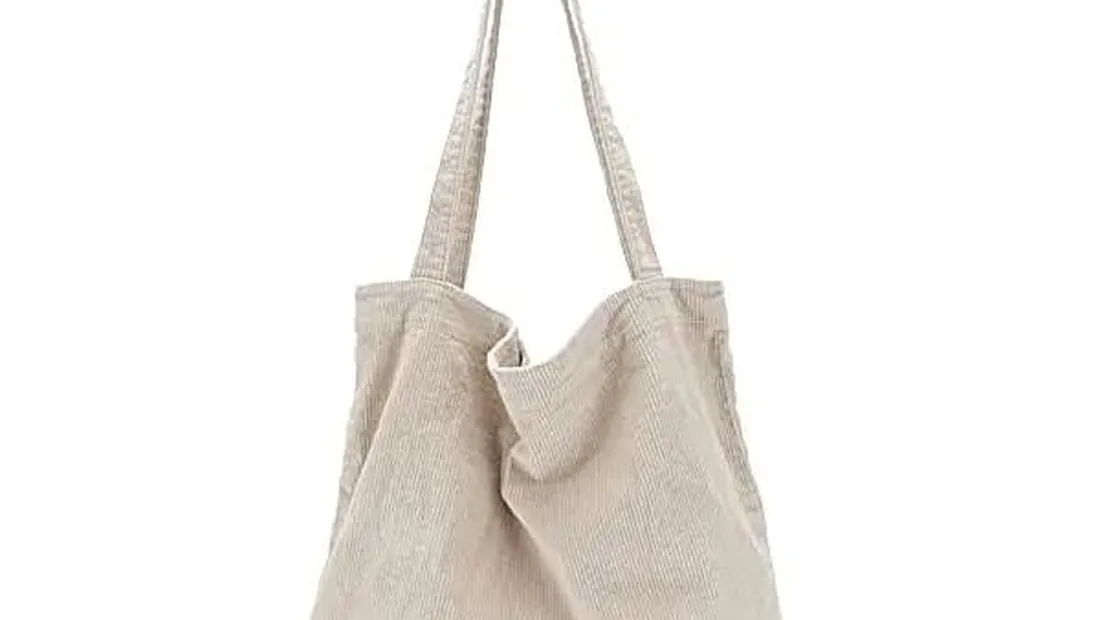
Start with the job the tote has to do
Wholesale tote bags are not one product. A grocery giveaway, a conference freebie, and a $18 boutique bag share a name. That's it. They differ in load, reuse, and feel. A thin giveaway can be flimsy. A resale bag can't. Get the spec wrong and the bag rips at the handle. Or it feels like a trash liner. The buyer remembers.
Think of a grocery chain ordering 5,000 totes for a weekend promo. The bag holds two milk cartons and a sauce jar. It gets used maybe three times. The chain wants the logo seen. Not a lifetime warranty. Now think of an event organizer buying 1,500 totes for a trade show. Those carry a brochure, a water bottle, a phone charger. Used once. Maybe twice. Now a boutique buying 300 totes to sell at $18 each. That bag is the product. It has to survive daily use for months. It still has to look good.
One rule applies. Material weight, gusset, handle reinforcement, and print method work together. Change one and you change the bag. A sourcing manager who sees a blank rectangle with handles will overpay for the giveaway. Or under-spec the resale item.
Choose the material by weight, not just by name
Buyers ask for "canvas" like it's one thing. It's not. Cotton canvas comes in ounce bands. Measured per square yard. Light canvas, around 8 ounces, drapes like a shirt. It folds flat. Good for conference swag. Midweight, 10 to 12 ounces, holds shape. Survives repeated loading. This is the workhorse. Heavy canvas, 14 to 15 ounces, is stiff and tough. Costs more. Good for premium resale or heavy grocery bags.
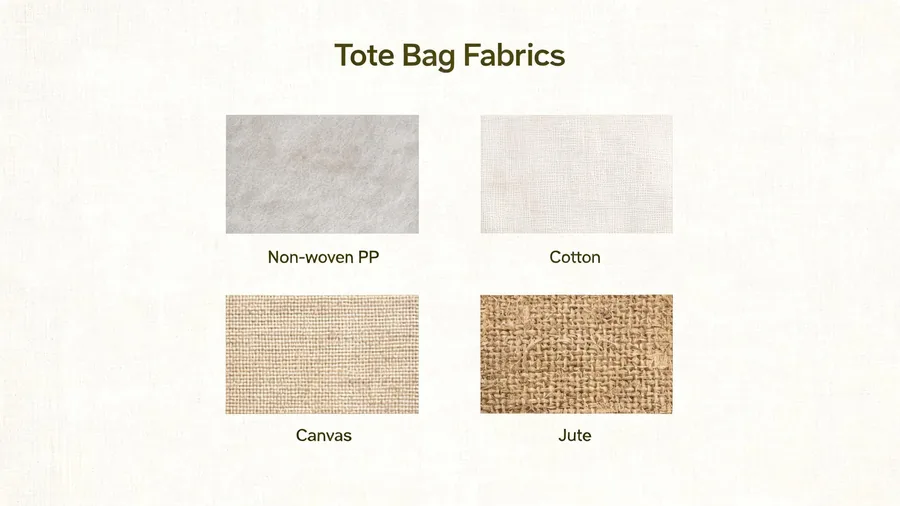
The ounce number matters more than the word "canvas." Two suppliers can use the same word for different fabrics. One quotes 8-ounce. The other 12-ounce. Same name, different product. Ask for ounces or GSM. GSM is grams per square meter. It works for synthetics and blends. Higher GSM means more material per area. Usually stiffer and more tear-resistant. Not always more printable. Coating and finish change that.
Jute is another material. Coarse bast fiber. Looks rustic. Fits earthy brands, farmers markets, eco retail. But jute doesn't screen print cleanly. The surface is uneven. It sheds fibers. For a grocery logo that must be crisp, jute is a compromise. For a boutique selling handmade, jute is the point.
Non-woven polypropylene is the cheapest. It's a bonded sheet, not woven. Holds a heat-transfer or screen print okay on smooth grades. It ages badly. After a few heavy loads, handles tear at the attachment. Fine for a one-day event. For resale, it's a warranty claim waiting.
Recycled cotton sits between canvas and jute. It has the sustainability story. Fibers are shorter than virgin cotton. So it can feel softer and slightly weaker at the same weight. A 10-ounce recycled tote may perform like an 8 or 9-ounce virgin one. Results vary by blend. Go slightly heavier if it will carry groceries.
Match the gusset and base to the load
A flat tote is two panels sewn together. It carries flat things: documents, a laptop sleeve, a folded shirt. Put two wine bottles in it. The bag becomes a pendulum. The load swings. Side seams stress. A gusseted tote has a third panel along the bottom and sides. That creates depth. The bag opens into a box. Weight spreads across a wider base.
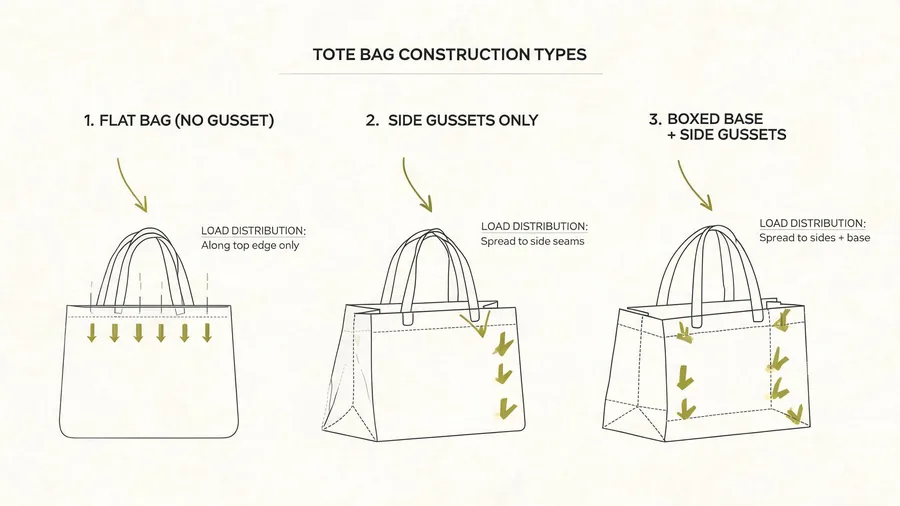
For groceries, a bottom gusset is almost required. A boxed base adds more stability. The bottom corners are folded and stitched into a rectangular footprint. The bag stands on its own. That helps at checkout when someone packs one-handed. A poly board insert goes further. It's a thin semi-rigid sheet in a sleeve at the base. It spreads the load across the whole bottom seam. Not just the corners. For a heavy canvas grocery tote, a poly board insert is cheap insurance against blowouts.
Conference swag bags rarely need a gusset. They carry light, flat items. Adding one adds fabric cost and shipping volume. No added perceived value. Retail totes vary. A flat fashion tote looks sleek on a shelf. A gusseted utility tote with a board insert looks ready for work. Match the base to the brand story.
Spec handles that won't fail first
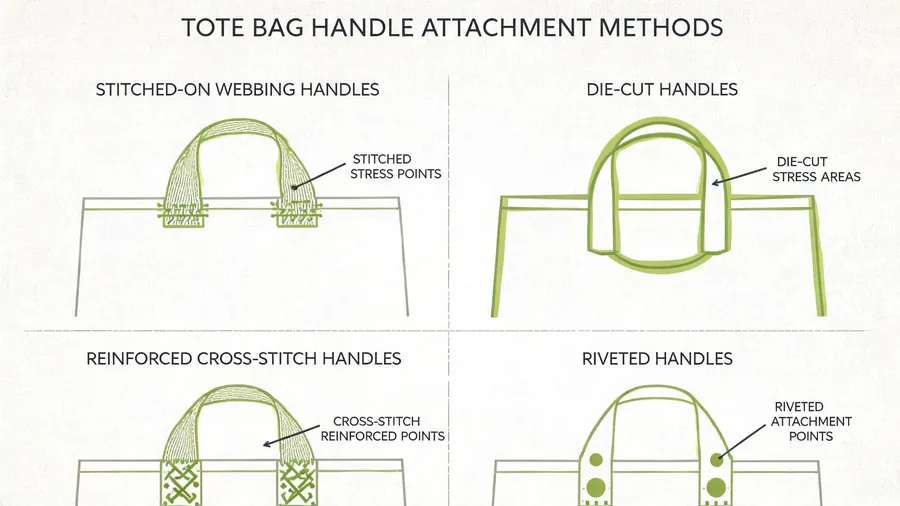
Handles fail before the body. Always. The attachment is the weak point, not the webbing. A handle sewn flat with one stitch row will tear under load. Fix it with reinforcement.
Handle drop is the vertical distance from the bag top to the inside top of the grip. A short drop, commonly around 5 to 7 inches, suits hand carry. A longer drop, commonly around 9 to 11 inches, allows shoulder carry. For groceries, shoulder carry matters. People walk with heavy bags. For conferences, hand carry is fine. Specify the drop. Don't let the factory choose.
Reinforcement matters more than handle width. A bar tack is a dense zigzag stitch at the attachment. Cross-stitching, an X or box pattern, spreads the pull over a wider area. Folded handle ends double the webbing before stitching. More material at the stress point. For a heavy grocery tote, specify bar tacks plus folded ends plus a box-X stitch. That survives repeated loading. For a light giveaway, a simple bar tack is enough.
Handle material should match the bag weight. Cotton webbing feels soft. Suits canvas. Nylon is stronger and dries faster. Can feel stiff. Polyester resists stretching and UV better. Width matters too. A half-inch handle digs into the hand under load. A one-inch handle spreads the pressure. Carrying 15 pounds or more? Go wider.
Pick a print method that suits the material
Screen printing is the default for cotton canvas. Ink sits on the surface. Bonds well to woven fibers. Bright, opaque colors. On jute, screen printing loses crispness. The coarse texture breaks fine lines. On non-woven PP, it works on smooth grades. It can flake on textured ones. Ask for a print test on the exact material first.
Heat transfer works differently. A design is printed on a carrier film. Then pressed onto the bag with heat and pressure. It suits coated or synthetic materials. Handles photographic detail better. The trade-off is durability. Heat transfer can crack or peel after washing or flexing. For a retail tote that gets washed, screen print on cotton canvas is safer. For a one-day non-woven PP bag, heat transfer is fast and cheap.
Texture and coating change everything. Coated canvas repels water. It also repels ink unless the coating is print-compatible. Rough jute needs a heavier ink deposit. Smooth non-woven accepts a clean print but gives the ink no tooth to grip. Specify print method and material together. Never separately.
Compare the three buyer scenarios in one table
| Scenario | Material | Weight band | Print method |
|---|---|---|---|
| Grocery giveaway | Cotton canvas or recycled cotton | 10 to 12 oz canvas; slightly higher for recycled | Screen print, one or two colors |
| Conference swag | Non-woven PP or light cotton canvas | Commonly around 70 to 100 GSM non-woven; 8 oz canvas | Heat transfer or screen print |
| Retail resale | Cotton canvas, jute, or recycled cotton | 12 to 15 oz canvas; jute varies by grade | Screen print, multi-color or specialty ink |
The table is a start. Real specs change with quantity, lead time, and brand needs. A grocery chain ordering 20,000 bags can justify a custom weight. A dedicated print setup too. A boutique ordering 200 bags pays more per unit. It should simplify the design. Don't let the table replace a factory conversation.
Turn the spec into a quote request
A clear spec cuts back-and-forth. It also cuts sample rounds. Include material by name and weight band. Finished dimensions. Gusset depth if any. Handle drop and width. Reinforcement details. Print method and number of colors. Quantity. If you know the target load, say so. A buyer who writes "canvas tote, 12 oz, 15x14x5 inch, 10 inch handle drop, box-X reinforcement, screen print two colors, 2,000 pieces" gets a useful quote on the first reply. A buyer who writes "canvas tote, medium, logo" gets a question back.
Specify the base too. Flat or gusseted. Poly board insert or none. These change price and performance. They aren't afterthoughts. The factories that make wholesale straw bags and PP woven shopping bags see both kinds of requests daily. Clear ones move faster. Vague ones stall.
For buyers exploring natural materials, the raffia versus straw comparison explains how fiber choice changes texture and durability. Still weighing canvas weights? The canvas weight guide breaks down the ounce bands. Send a spec, not a wish. The quote comes back faster. So does the sample round.
Frequently Asked Questions
Where can I find wholesale tote bags?
You can source wholesale tote bags from manufacturers in major bag-producing regions, including Yiwu in China. Look for a supplier that offers the material you need, cotton canvas, jute, non-woven PP, or recycled cotton, and that can match your weight band and print method. Ask for a material sample before you commit to a bulk order.
Can I buy totes in bulk?
Yes. Bulk ordering is the standard way to buy tote bags for giveaways, events, or resale. Minimum order quantities vary by material and construction. A simple non-woven PP tote often has a lower minimum than a heavy cotton canvas tote with a gusset and reinforced handles. Send your full specification to get an accurate minimum.
Where can I wholesale heavy-duty canvas tote bags?
Heavy-duty canvas totes come from suppliers that specify fabric by ounce weight, not just by the word canvas. Look for a manufacturer that offers 12 to 15 ounce cotton canvas and can add a bottom gusset, a poly board insert, and reinforced handle attachments. Request a pre-production sample to confirm the fabric weight and stitching.
What should I look for when buying wholesale tote bags for printing?
Check the material weight, surface texture, and any coating. Cotton canvas screen prints well, while jute produces a rougher result and non-woven PP works best with heat transfer on smooth grades. Ask your supplier to run a print test on the exact material you will order. Confirm the ink adhesion and wash durability before approving production.
Sourcing woven bags?
Send your questions to the factory directly. We reply within 24 hours.
Request a Quote