Eco Friendly Tote Bags: Materials and Honest Claims
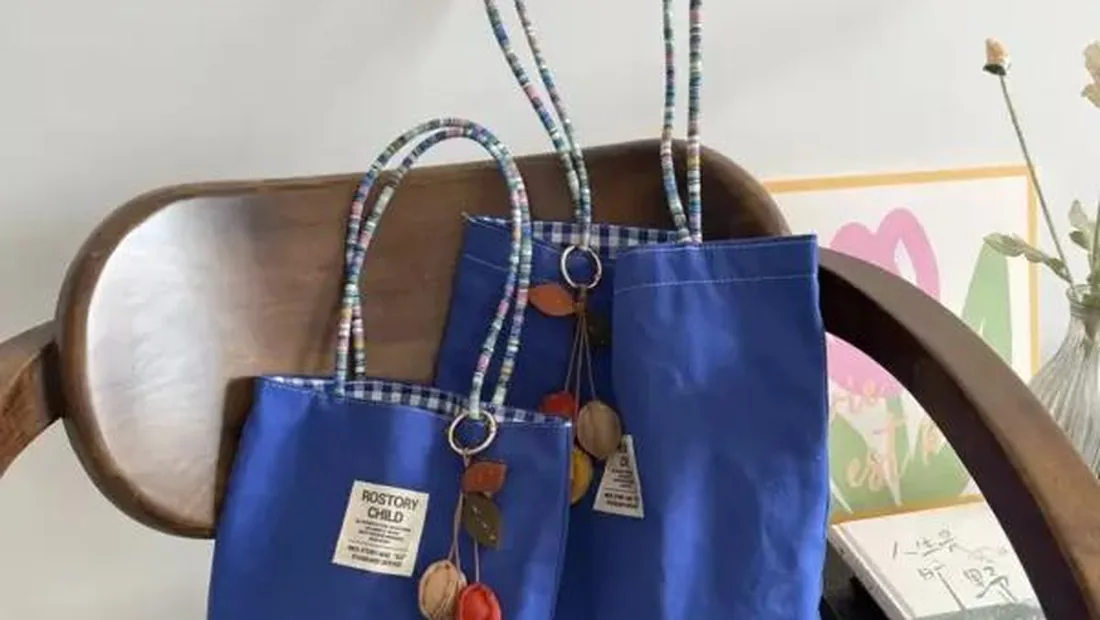
"Eco friendly tote bags" is one of the easiest phrases to print on a hang tag. It's also one of the hardest to defend. Say a retailer orders 5,000 printed totes for a spring promotion. The marketing team wants the words "sustainable" and "recycled" on the front. Somebody downstream has to prove those words are true. That somebody is usually you.
This guide walks through the materials, the ink systems, the certificate paperwork and the end-of-life questions. Those are the things that decide whether a tote claim survives contact with a buyer, a regulator or a customer with a phone. Nothing here is a claim about any particular supplier. It's a checklist you apply to whoever you buy from.
What 'Eco-Friendly' Actually Means for a Tote Bag
Here's the uncomfortable part. The material label is not the dominant environmental variable. Reuse count is.
Think about the arithmetic. A tote carries a production footprint: fiber growing or polymer production, spinning, weaving, dyeing, printing, cutting, sewing, packing, freight. That footprint is fixed the moment the bag is made. What varies afterward is how many trips the bag makes before it tears, stains or gets thrown out. Divide a fixed impact by a bigger number and the per-trip impact falls. Divide it by two and you have a very expensive bag.
So a thin promotional tote that rips at the handle on trip four is worse than a heavier bag that lasts years. That holds even if the thin one carries a recycled-content claim. That's not a controversial position. It's just division.
A material claim without a named standard and a certificate scope is marketing. Full stop. "Made with recycled fibers" tells you nothing about which fibers, what percentage, or whether anyone verified it. "Certified recycled under a named scheme, certificate covering this material at this facility" tells you something you can put in a file. The gap between those two sentences is where greenwashing complaints live.
Why cheap totes never reach the break-even point
Light totes fail in predictable places. The handle attachment pulls out of the body because the anchor is a single stitch line with no reinforcement patch. The bottom seam splits under a loaded grocery run. The fabric is so thin that a bottle corner abrades a hole within a season.
None of those failures are about the fiber. They're about construction. A bag built to survive needs three things. A reinforced handle anchor. A gusset that carries load rather than just adding depth. A base that doesn't rely on one row of stitching. Specify those three things and you've already done more for the environment than swapping one fiber for another.
Material Options Compared: Organic Cotton, Recycled Cotton, Recycled PET, Jute, Hemp
Five materials dominate the tote conversation. Each has a different hand, a different failure mode and a different claim you should ask to see verified.
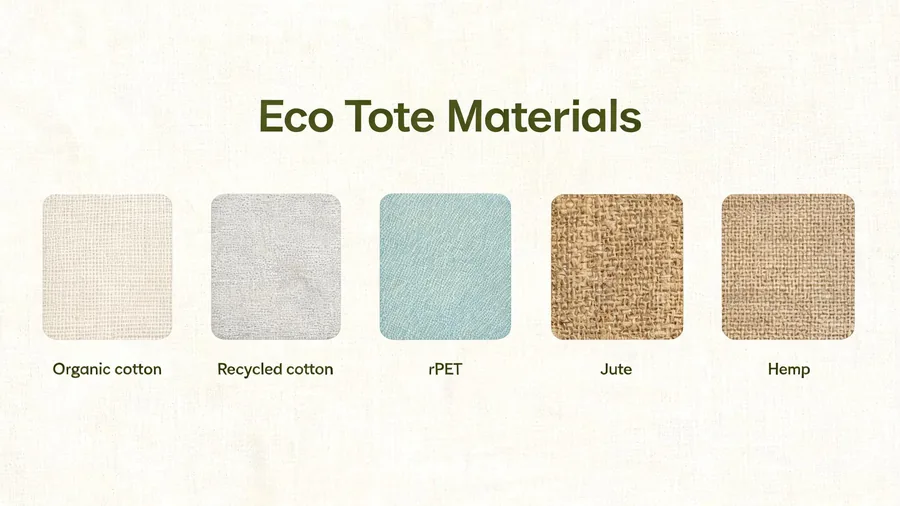
| Material | Feel and structure | Durability consideration | Claim to verify |
|---|---|---|---|
| Organic cotton | Soft, natural drape, takes print well, folds flat | Abrasion resistance depends on fabric weight and weave; heavier canvas holds shape longer | Organic status under a named standard, with the certificate scope naming the material and facility |
| Recycled cotton | Similar hand to virgin cotton, often slightly shorter fiber and a touch more variable | Shorter staple fibers can mean faster surface wear; construction quality matters more here | Recycled content percentage and the chain-of-custody document behind it |
| Recycled PET (rPET) | Crisp, smooth, holds a crease, prints with sharp edges | Good tear and abrasion performance; heat and heavy UV exposure are the watch items | Recycled content claim under a named certification, plus confirmation the trim and print allow re-recycling |
| Jute | Coarse, stiff, strong, distinctly textured; softens with use | Very high tensile strength; edges fray if not bound, and the weave can shed fibers | Fiber origin and any natural-fiber certification named on the certificate |
| Hemp | Similar to linen, gets softer with washing, strong and slightly irregular | Excellent tensile and abrasion resistance; less uniform dye uptake than cotton | Fiber content percentage and any organic or natural-fiber standard named in writing |
Two of those columns matter more than buyers expect. Feel decides whether the bag gets used at all. A stiff jute tote that scratches a shoulder gets left at home. An unused bag has an infinite per-trip footprint. Durability consideration decides how many trips it survives once it does get used.
On the claim column, the pattern is the same for all five. Name the standard. Name the scope. Name the facility. If a supplier can't produce that in writing, treat the claim as unverified. For fabric vocabulary like GSM, denier and canvas ounces, the canvas weight guide covers how those numbers interact with structure and print.
Why Reuse Beats the Material Label
Lifecycle thinking reduces to one fraction: production impact divided by number of uses. You can attack the numerator by choosing lower-impact fiber. You can attack the denominator by making the bag last longer. The denominator is usually cheaper to move.
Construction details decide the denominator. Four of them do most of the work.
- Handle attachment. A box-X stitch with a reinforcement patch spreads load across the panel. A single straight stitch concentrates it at one point and pulls through.
- Gusset depth and shape. A gusset carries weight down the sides instead of letting the base stretch. A flat two-panel bag with no gusset is a strain on every seam.
- Base reinforcement. A base panel with a bound edge or a doubled layer resists corner wear from bottles and boxed goods.
- Seam type. Overlocked seams are fast. Bound or flat-felled seams cost more and last longer under load.
Now specify for the trips the end user will realistically make. A grocery tote used twice a week for three years is a different animal from a conference giveaway used four times and forgotten. The grocery bag justifies heavier fabric, a reinforced base and a proper handle anchor. The giveaway bag justifies almost nothing. That's exactly why it shouldn't carry a sustainability claim.
Woven and natural-fiber constructions follow the same logic. The wholesale straw bags page shows how handle and rim construction vary between styles. That variation is what determines whether a bag survives a summer or a single season.
Inks, Dyes and Finishes: The Hidden Variable
Buyers spend weeks on fiber and five minutes on ink. That's backwards. Ink and dye choices can quietly invalidate a claim you already paid for.
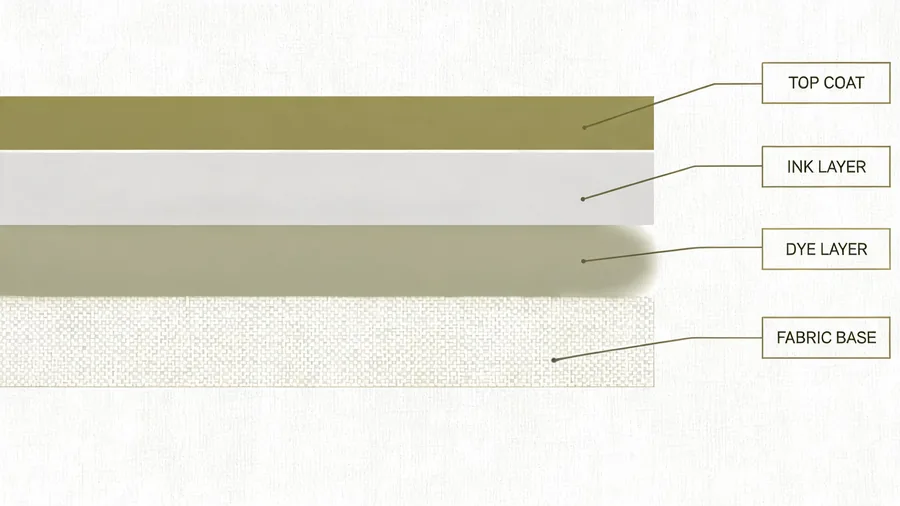
Screen printing pushes ink through a prepared screen onto the material. It suits solid colors and repeat runs, and it works best when the substrate and ink system are matched. Digital textile printing lays down artwork by controlled inkjet deposition. That handles detail and short runs and needs ink chemistry chosen for the fiber type. Dye sublimation turns disperse dye into gas that bonds with suitable polyester surfaces under heat and pressure. That last one is why rPET and sublimation pair so naturally, and why the same process on cotton simply doesn't take.
Then there's the ink chemistry itself. Water-based systems and plastisol systems behave differently on the same fabric. One sits on the surface, one penetrates and cures differently, and they age, crack and wash differently. If a brand wants to describe a printed tote as low-impact, the ink system is part of that sentence. A certified fabric printed with an uncertified ink is a half-certified bag.
Colorfastness is the testable version of this argument. It measures resistance to color change or transfer during rubbing, washing, light exposure or contact with moisture. Recycled and organic fibers can take dye less uniformly than virgin fiber, especially recycled cotton with its shorter staple length. Ask how colorfastness was validated on the actual substrate, not on a generic swatch.
Finishes matter too. A waxed or coated surface changes how the bag behaves at end of life. A lamination can sit between the certified material and the outside world. Whatever the finish is, it belongs in the spec sheet.
What an Honest Sustainability Claim Needs
An honest claim matches the scope of a named standard's certificate. Not the supplier's reputation. Not a logo on a website. The certificate, and the specific material or facility it covers.
Standards bodies publish their own rules. Those rules are worth reading directly rather than taking secondhand. The Global Organic Textile Standard sets requirements for organic fiber through the supply chain. The Global Recycled Standard covers recycled content, chain of custody and social and environmental criteria. Both are administered by named organizations with public documentation. Check current guidance on the issuing body's own site rather than relying on a summary. Scopes and versions change.
Vague words invite scrutiny. "Green," "earth-friendly" and "eco" carry no defined meaning in most markets. Regulators in both the US and the EU have been tightening their stance on unsubstantiated environmental claims. A claim you can't document is a claim you may have to withdraw, sometimes publicly.
So here's what to request before you sign off on any eco claim for your own label.
- Certificate number and the issuing body that granted it.
- The exact facility or material the certificate covers, in writing.
- The recycled or organic content percentage, stated as a number, not a range.
- The ink and dye system used on the production run, with its own documentation if the claim depends on it.
- A production sample that matches the certified material, so the approved sample and the shipped goods are the same thing.
Item five is the one buyers skip. A certificate covering a material means nothing if the production run uses a substitute. Lock the claim to the sample and the sample to the run.
End-of-Life: What Happens After the Last Trip
Every tote eventually stops being a tote. What happens next depends on fiber, coating and trims. Those three interact in ways that aren't obvious at the design stage.
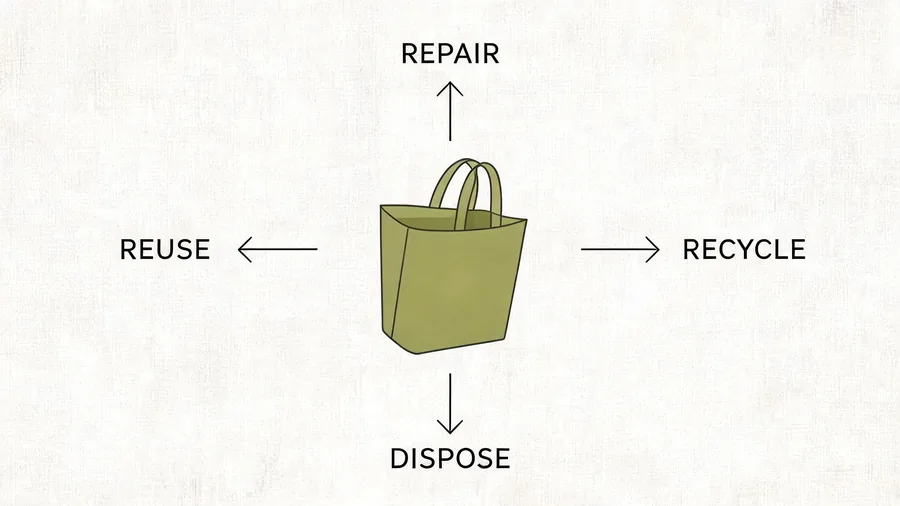
Biodegradability varies by fiber and by whatever coating or lamination sits on it. A natural fiber with a plastic laminate is no longer a biodegradable object. A cotton tote with a synthetic webbing handle and a metal rivet is a mixed-material problem at the recycling facility. Mixed-material problems usually end up in general waste.
Recycled PET totes can re-enter recycling streams, but only if the trims and prints allow it. A large plastisol print, a glued reinforcement, a metal grommet or a mixed-fiber binding can each be enough to send the whole bag to landfill. Design choices that keep a tote repairable or returnable beat design choices that look good in a photo.
Practically, that means choosing mono-material construction where possible. Keep trims removable. Specify prints that a recycler can tolerate. If your end-of-life story is a take-back program, the bag has to be built so the program can actually process it.
Spec Sheet Checklist Before You Place a Wholesale Order
Everything above collapses into a short list you can paste into a purchase order. Fabric weight and construction terms belong in the spec by name: GSM for mass per area, denier for yarn linear density, canvas ounces where the trade uses them. Denier describes the yarn, not the finished fabric's strength, so pair it with a weight and a weave description. The wholesale canvas bags guide walks through how those terms behave in a real specification.
Beyond fabric, confirm in writing: certificate scope, ink system, handle attachment method, gusset depth, base reinforcement and seam type. Then set sample approval points that lock the eco claim to the actual production run. Not to a development sample that was never going to ship.
For buyers working in natural fibers, the raffia bags wholesale page covers how fiber selection and construction interact in that category. The same discipline applies. Name the material. Name the construction. Document the claim.
If you have a spec in hand and want a quote against it, send it through the contact page and it will be reviewed line by line.
Frequently Asked Questions
What is the most environmentally friendly bag?
The one that gets used the most times. Production impact is fixed once a bag is made, so per-trip impact falls as reuse count rises. A durable bag in a conventional fiber usually beats a flimsy bag in a certified fiber. The flimsy one fails early and the division never works out. Material choice matters, but construction and reuse matter more.
What are eco-friendly tote bags made of?
The common options are organic cotton, recycled cotton, recycled PET, jute and hemp. Each has a different hand, a different failure mode and a different claim that needs verifying. Organic cotton and hemp lean on fiber-origin standards. Recycled cotton and rPET lean on recycled-content and chain-of-custody documentation. Jute leans on fiber origin and natural-fiber certification. In every case, the claim is only as strong as the certificate scope behind it.
What should a brand verify before calling a tote bag sustainable?
Ask for the certificate number, the issuing body, and the specific facility or material the certificate covers. Get the recycled or organic content as a number. Confirm the ink and dye system used on the run, since an uncertified ink on certified fabric leaves the bag half-certified. Then approve a production sample that matches the certified material, so the approved sample and the shipped goods are the same object.
How do you compare organic cotton, recycled cotton and recycled PET totes for a wholesale order?
Compare them on three axes: feel, durability consideration and claim to verify. Organic cotton drapes softly and prints well. Recycled cotton feels similar but often has shorter staple fiber, so construction quality carries more weight. Recycled PET is crisp, holds a crease and prints with sharp edges, with heat and heavy UV as the watch items. On claims, cotton leans on fiber-origin standards and rPET leans on recycled-content standards, each with its own documentation requirement.
Sourcing woven bags?
Send your questions to the factory directly. We reply within 24 hours.
Request a Quote